Forts, Temples, Waterfalls & Hidden Wonders of the Deccan
Overview
Discover Ahilyanagar's Remarkable Destinations
Ahilyanagar district is a landscape of extraordinary contrasts: ancient stone fortifications rise from flat Deccan plains; sacred shrines draw millions of pilgrims from across India and the world; mountain streams tumble over basalt cliffs into jewel-green pools; and trekking trails cut through forests dense enough to hide leopards and gaur. Few Indian districts offer such a diverse menu of tourist experiences within a compact geographic footprint, and the improving road network means that even the most remote attractions are now accessible without undue hardship.
This comprehensive guide covers every major tourist attraction in Ahilyanagar, from the internationally famous to the little-known gems that reward the curious traveller willing to venture beyond the well-trodden path. Each listing includes location details, best visiting times, duration suggestions, and insider tips drawn from extensive research and the experiences of thousands of travellers who have explored this magnificent district.
We have organised the attractions into thematic categories — historical monuments, spiritual sites, natural wonders, and adventure destinations — though in practice, the lines between these categories blur pleasingly. A trek to Harishchandragad is also a journey through geological history. A pilgrimage to Shani Shingnapur is also an encounter with a fascinating living cultural tradition. And a day at Bhandardara is simultaneously a nature immersion and a meditation on the human ingenuity that built Arthur Lake's dam a century ago.
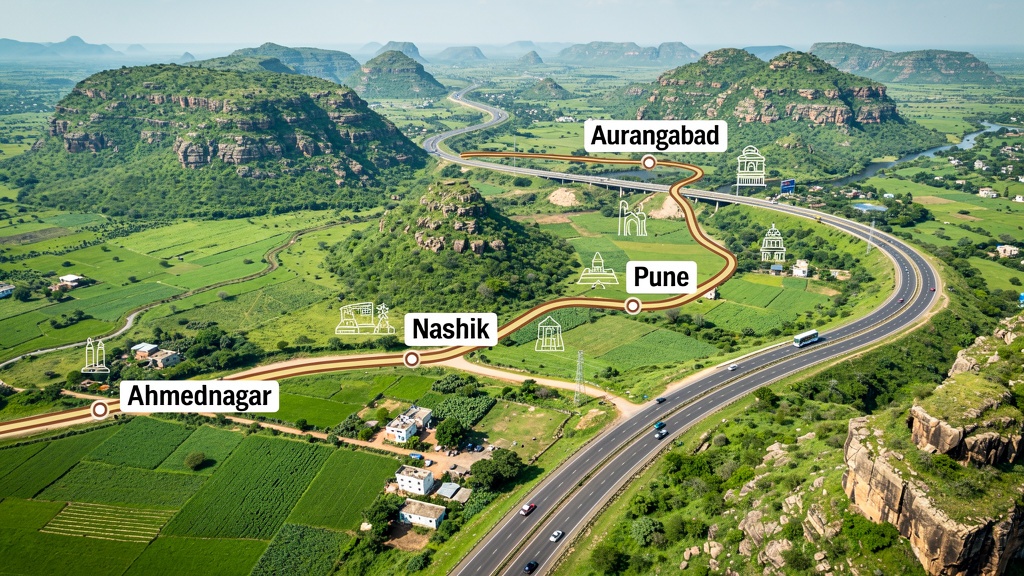
The district's attractions are distributed across its fourteen talukas, but the main tourist circuit is reasonably compact. Most visitors base themselves in Ahmednagar city, from where Shani Shingnapur (85 km), Bhandardara (110 km), and the city's own heritage monuments are accessible as day trips. Harishchandragad and Meherabad can also be covered from the same base, though Bhandardara benefits from an overnight stay to experience the lake at dawn and dusk.
📍 Visitor Tip
Download offline maps before visiting Ahilyanagar's rural attractions. Mobile connectivity in the Sahyadri foothills and remote talukas can be patchy. MTDC offices in Ahmednagar city provide free printed maps and up-to-date entry fee information.
Entry fees at most government-maintained sites are nominal — typically between ₹20 and ₹100 for Indian nationals and slightly higher for foreign visitors. Photography charges apply at some monuments, particularly the Fort. The best approach for a comprehensive exploration of the district's attractions is to allow a minimum of four to five days, though a well-planned week would do justice to the full range of experiences on offer.
🏰 Est. 1490 CE
Historical Monument
Ahmednagar Fort
HeritageArchitectureFreedom StruggleMuseum
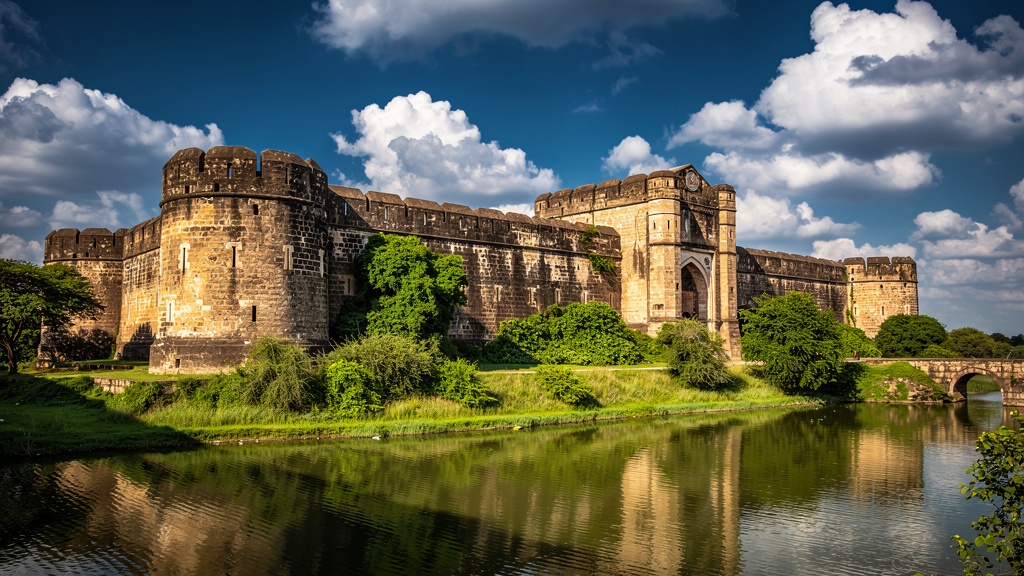
The Ahmednagar Fort is undoubtedly the most historically significant monument in the district and one of the finest medieval military structures in the entire Deccan. Built between 1490 and 1560 CE during the reign of the Nizam Shahi Sultanate, the fort's circular plan — a radical departure from the conventional rectangular fort design of the period — reflects an advanced understanding of geometric defensive principles. Its 22 bastions, arranged at precise intervals around the circumference, provided overlapping fields of fire and eliminated the blind spots that plagued conventional rectangular designs.
The moat, originally filled with water and later converted to a dry ditch, added another formidable layer of defence. The fort withstood multiple sieges over its long history, including a prolonged Mughal assault in 1600 CE during which the fort's defenders — led by the formidable regent queen Chand Bibi — repelled the imperial army before finally being overwhelmed. This siege, and Chand Bibi's heroic resistance, is one of the celebrated episodes of Deccan history and gave rise to one of the region's enduring legends.
In later centuries, the British converted the fort into a prison. Its most famous inmates were the Congress leaders imprisoned here during the Quit India Movement (1942–1945): Jawaharlal Nehru, Maulana Abul Kalam Azad, Sardar Vallabhbhai Patel, Narendra Deva, and others. Nehru used his three years of imprisonment here to write The Discovery of India — a brilliant work of historical synthesis that remains a foundational text of modern Indian thought.
Location: Ahmednagar city centre, approx. 2 km from bus stand
Visiting Hours: 8:00 AM – 5:30 PM (Closed Mondays)
Entry: ₹25 (Indian); ₹200 (Foreign nationals)
Duration: 2–3 hours recommended
What to See Inside the Fort
The fort is currently maintained by the Indian Army, which has opened a portion of the grounds to civilian visitors. The main attraction for most visitors is the Nehru Museum, located within the fort premises. This thoughtfully curated museum documents the Congress leaders' imprisonment here, displaying original furniture, personal effects, photographs, and manuscripts. The cell where Nehru wrote portions of Discovery of India has been preserved as a heritage room, and the sight of the simple desk and narrow window through which he observed the Deccan sky gives the abstract history an immediate human dimension.
The fort's outer walls, accessible on guided walks, reveal the exceptional quality of the stonework — massive basalt blocks fitted without mortar, using the sophisticated dry-stone technique common to Deccan Sultanate construction. The bastions, several of which rise to over 20 metres, command panoramic views of Ahmednagar city and the surrounding plains. On clear winter mornings, the distant outline of the Sahyadri can occasionally be seen on the western horizon.
The water supply system within the fort deserves special attention. A sophisticated network of underground cisterns, channels, and wells ensured that the fort's garrison could withstand extended sieges without running short of water. This hydraulic engineering, integrated seamlessly into the fort's overall plan, is characteristic of the high technical standards the Nizam Shahi builders brought to their constructions.
Historical Significance: Chand Bibi and the Mughal Siege
The siege of Ahmednagar Fort in 1595–1600 CE is one of the most dramatic episodes in Deccan history. When the Mughal Emperor Akbar dispatched his son Prince Murad with a massive army to reduce the Nizam Shahi Sultanate, the young Sultan Bahadur Nizam Shah was barely eight years old. His regent, Chand Bibi, stepped forward to lead the defence — and in doing so secured her place in the annals of Indian history as one of the continent's most formidable female leaders.
Chand Bibi, a princess of the Adil Shahi Sultanate of Bijapur by birth and widow of the Nizam Shahi Sultan Ali Adil Shah I, combined diplomatic skill with personal courage to mount a defence that kept the Mughal army at bay for months. When a section of the wall was breached by Mughal cannon fire, Chand Bibi herself reportedly led a party of soldiers to repair it under fire — an act of personal bravery that inspired her demoralized garrison to hold out. She ultimately negotiated a treaty that preserved the Sultanate's nominal independence, though the fort eventually fell to the Mughals in 1600 CE.
The story of Chand Bibi has been extensively commemorated in Marathi literature, folk memory, and popular culture, and a visit to the fort is considerably enriched by familiarity with this extraordinary woman's story. Local guides — available at the fort entrance — are particularly enthusiastic about narrating the siege's details with considerable dramatic flair.
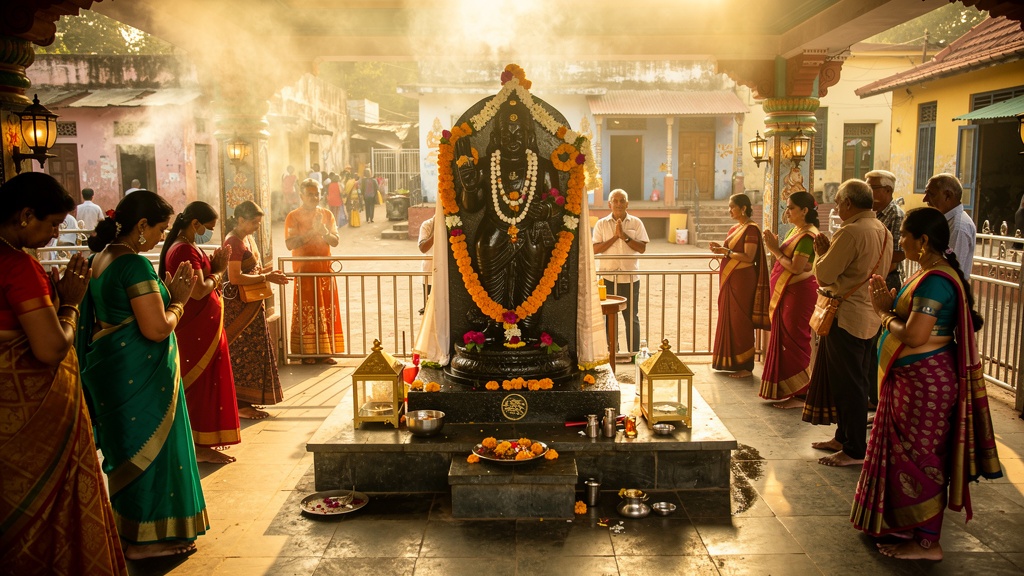
Approximately 85 kilometres from Ahmednagar city and 35 kilometres from Shirdi, the village of Shani Shingnapur is home to one of India's most distinctive religious phenomena. The village is famous throughout India for two things: its powerful temple dedicated to Lord Shani (Saturn), the most feared and respected of the nine Navagraha planets in Hindu astrology; and its extraordinary community tradition of building homes, shops, public buildings, and even the local bank branch without doors or locks.
The central object of devotion is a black self-manifested swayambhu stone, approximately 1.5 metres in height, which stands exposed on an open platform under the sky. Unlike most Hindu temples, there is no sanctum sanctorum, no roof, no walls — Lord Shani is worshipped in the open air, accessible to all. The stone is anointed with mustard oil by devotees who believe that propitiation of Shani removes obstacles, ill-luck, and the malefic effects of Saturn's position in their astrological charts.
Location: Shani Shingnapur village, Nevasa taluka (85 km from Ahmednagar)
Visiting Hours: 5:30 AM – 10:00 PM daily
Entry: Free. Mustard oil for abhishek available at stalls (₹10–₹50)
Best Day: Saturday (Shaniwar) sees largest gatherings; visit weekday for more contemplative experience
The Legend of Shani Shingnapur
The legend behind the temple's origins is as dramatic as the place itself. According to local tradition, approximately three hundred years ago, a local shepherd discovered the black stone partially buried in the earth, its surface oozing blood when accidentally struck with a stick. That night, Lord Shani appeared in the shepherd's dream and identified himself as the black stone, requesting that he be established under the open sky — not enclosed within a temple — so that his gaze could survey all directions simultaneously. The shepherd was also told that any home in the village that placed a door or lock on its entrance would incur Shani's displeasure.
The village followed these instructions faithfully, and the tradition of doorless homes has been maintained for centuries. Today, approximately three hundred homes in the core village area are still built without doors, and the community reports that the incidence of theft and crime is negligible. The local police station also famously had no doors or locks for many years, though a nominal door has since been added for administrative purposes.
The village also hosts the world's first doorless UCO Bank branch, established in 2011 as a gesture of faith in Shani's protection. The bank building has no conventional security doors, and the lockers are reportedly never locked. It has become an attraction in its own right — visitors from the banking and finance world make specific pilgrimages to see this extraordinary institution operating under divine rather than conventional security protocols.
Visiting Shani Shingnapur: Practical Notes
The Shani Shingnapur experience is most powerful on Saturday mornings, when the temple's weekly major puja takes place and the village fills with devotees from across Maharashtra, Gujarat, Karnataka, and beyond. The atmosphere on these days is intensely devotional, the air thick with incense and the sound of bells, conch horns, and devotional singing. However, the crowds on peak Saturdays can be very substantial — queues of several hours are common during festival seasons.
Weekday visits offer a more contemplative experience. The temple complex is still busy — it is one of India's most visited temples, after all — but the pace is gentler and you have more opportunity to observe the rituals in detail and interact with the priests who are generally welcoming of genuine questions from curious visitors.
Photography at the main deity is technically restricted, though the restriction is inconsistently enforced. Photography of the surrounding village and the doorless homes is generally acceptable; simply ask permission before photographing individual homes or their residents. Dress code is relatively modest — shoulders covered and legs covered below the knee is the respectful standard. Footwear must be removed before entering the temple precinct.
The village is surrounded by a range of food stalls, shops selling puja materials, and accommodation options ranging from basic guesthouses to more comfortable hotels. The local cuisine offers an excellent opportunity to try authentic Maharashtrian roadside cooking — the Misal Pav and Vada Pav available from the stalls near the temple are reliably excellent.
Natural Wonder
Bhandardara – Maharashtra's Most Romantic Escape
LakeWaterfallsTrekkingWildlifePhotography
Tucked into the folds of the Western Ghats in the Akole taluka of Ahilyanagar district, Bhandardara is the destination that Maharashtrian families, couples, and nature lovers return to again and again across the seasons. Each season reveals a dramatically different face: the monsoon transforms the landscape into a lush green paradise cascading with waterfalls; winter brings crisp blue skies and perfect trekking conditions; and the brief post-monsoon transition creates a golden-lit paradise of reflective lakes and mist-draped hills.
At the heart of the Bhandardara experience is Arthur Lake, created by the Wilson Dam on the Pravara River. Completed in 1910 — a remarkable feat of colonial-era hydraulic engineering — the dam created a large and irregularly shaped reservoir that fills an entire valley between the surrounding Sahyadri peaks. The lake is most dramatically beautiful in the early morning, when it reflects the surrounding forest in perfect stillness, and in the late afternoon, when the light turns warm and golden on the water and the forest edges. Boating on Arthur Lake is a popular activity; boats are available for hire from the MTDC boathouse.
The Umbrella Waterfalls (also known as Randha Falls) are Bhandardara's most spectacular natural feature. During the monsoon and early post-monsoon season, the Pravara River plunges over a cliff in a spectacular horseshoe shape that gives the falls their umbrella nickname. At peak flow, the falls are among the most impressive in Maharashtra, with a water volume and drop height that create a noise audible from several kilometres away.
Location: Akole Taluka, 110 km from Ahmednagar, 165 km from Mumbai
Best Season: July–October (waterfalls); November–February (trekking)
Ideal Stay: Minimum one night for lake sunrise experience
🌊 Arthur Lake, 1,922 hectares
Trekking and Adventure at Bhandardara
The Bhandardara region serves as a gateway to some of Maharashtra's most rewarding trekking routes. Ratangad Fort, perched dramatically above the Bhandardara plateau at 1,297 metres, offers a moderate trek of approximately 5 kilometres (one way) through beautiful mixed forest. The fort itself — a Maratha-era construction guarding a mountain pass — is in atmospheric ruins, with sections of wall and gateway still standing. The views from the summit over the Arthur Lake basin and the surrounding Sahyadri ridges are magnificent.
Kalsubai Peak, the highest point in the state of Maharashtra at 1,646 metres, is accessible from the Bhandardara base. The climb, while steep in sections, is manageable for reasonably fit trekkers and the summit views — stretching to Nashik in one direction and Pune in another on clear days — are genuinely spectacular. The approach trail passes through tribal villages of the Mahadeo Koli community, and cultural encounters along the route enrich the physical experience considerably.
Sandhan Valley (the Valley of Shadows), accessible from a village near Bhandardara, is a dramatic gorge cut by a seasonal stream through the basalt plateau. Exploring the valley involves a combination of walking along stream beds, scrambling over boulders, and occasionally swimming through short gorge sections. Local guides are essential and available from Samrad village. The valley's sheer walls and geological drama make it one of Maharashtra's most extraordinary natural sites.
Birdwatching at Bhandardara
The forest surrounding Arthur Lake is a birdwatcher's paradise. The area lies within the Western Ghats biodiversity hotspot, and the recorded species list for the Bhandardara region extends to over 200 species. Winter months bring migratory waterfowl to the lake, including bar-headed geese, common pochard, and various wader species. The forest edges host a remarkable range of resident species including Malabar whistling thrush, Indian paradise flycatcher, Indian scimitar babbler, and the spectacular Indian pitta during the monsoon.
Several of the forest trails offer outstanding birdwatching, particularly in the early morning hours before visitor traffic disturbs the avian activity. The MTDC resort sits within a garden that itself is excellent for birding, with forest kingfishers, white-rumped munia, and sunbirds common visitors.
Bhandardara Firefly Festival
Every year during June–July, the forests around Bhandardara become home to thousands of synchronously flashing fireflies — one of nature's most magical spectacles. The Maharashtra Tourism Development Corporation (MTDC) organizes a Firefly Festival during this season, with evening walks into the forest to witness the display. Advance booking is essential as this is one of the most popular ecotourism events in Maharashtra.
⛰️ 1,424 metres altitude
Adventure Trekking
Harishchandragad – Maharashtra's Most Revered Trek
TrekkingAncient TempleCliff ViewsOvernight Camp
Harishchandragad is, for many Maharashtrian trekkers, a rite of passage. Rising to 1,424 metres above sea level in the Malshej Ghat region straddling the Ahilyanagar and Pune district boundaries, this ancient hill fort combines the physical challenges of a demanding mountain trek with the spiritual rewards of an ancient Shaiva temple complex. The ancient Harishchandra Temple at the summit — dating to the 6th century CE — is dedicated to Lord Harishchandra, the legendary king celebrated in Hindu mythology for his supreme commitment to truth and dharma.
The trek to Harishchandragad offers multiple route options of varying difficulty. The popular Khireshwar route (approximately 5–6 hours one way) passes through beautiful forest and grassland, with the landscape opening dramatically as you approach the summit plateau. The more challenging Nalichi Vaat route (not for the faint-hearted — involves near-vertical climbing sections) tests even experienced trekkers but delivers an unmatched sense of achievement.
Ancient Harishchandra temple with cave carvings and underground tank
Kokan Kada cliff — one of Maharashtra's most dramatic viewpoints
Kedareshwar cave with Lord Shiva lingam surrounded by water
Best for overnight camping: sunrise over the Sahyadri is unforgettable
🕊️ Visitors from 80+ Countries
Spiritual Destination
Meherabad – Meher Baba's Eternal Home
PilgrimageUniversal SpiritualityArchivesHeritage
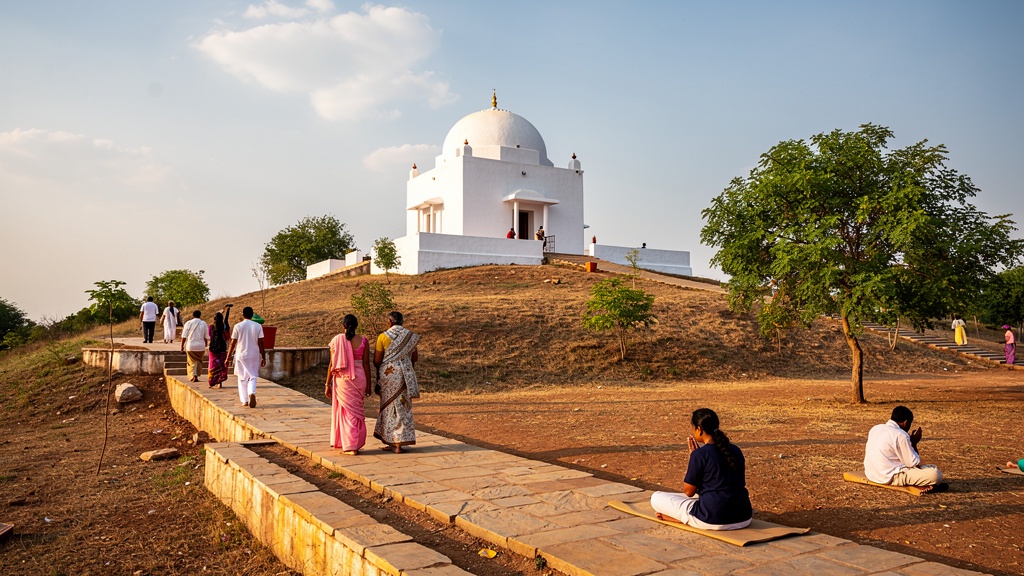
Located near the village of Arangaon, approximately 15 kilometres south of Ahmednagar city, Meherabad is the spiritual community and pilgrimage site established in 1923 by Meher Baba (1894–1969), one of the 20th century's most universally beloved spiritual figures. Born Merwan Sheriar Irani to a Zoroastrian family in Pune, Meher Baba spent decades travelling the world and maintaining silence (from 1925 until his death in 1969, he communicated entirely through an alphabet board and hand gestures), yet his message — summarized in the phrase "Don't worry, be happy" — reached millions and continues to inspire seekers across all religious traditions.
The Samadhi (tomb) of Meher Baba crowns a small hill above the lower Meherabad settlement. The tomb, a simple domed structure built to Baba's own specifications during his lifetime, is the focal point of pilgrimage. Visitors are welcomed warmly regardless of religious background; there is no expectation of any particular belief or practice. The atmosphere at the Samadhi is one of profound stillness, especially in the early morning before the main daily visitor hours.
Location: Arangaon village, 15 km south of Ahmednagar city
Visiting Hours: 7:00 AM – 6:00 PM (Samadhi open daily)
Entry: Free. Donations optional.
More to Explore
More Attractions in Ahilyanagar
Beyond the headline destinations, Ahilyanagar district is filled with lesser-known but equally rewarding sites that reward the curious and patient traveller.
Architectural Heritage
Salabat Khan's Tomb
A magnificent two-storeyed octagonal tomb built for a Nizam Shahi general, rising on a high plinth amid formal garden enclosures. One of the finest examples of Deccan Sultanate funerary architecture, remarkable for the precision of its geometric stonework. Located 2 km from Ahmednagar city centre.
HeritagePhotography
Trekking
Ratangad Fort
A moderate-to-challenging Maratha hill fort near Bhandardara, sitting at 1,297 metres and offering commanding views over Arthur Lake and the Sahyadri. The unique carved window at the summit — Nedhe — is one of the Sahyadri's most photographed natural features. 7 km trek from base village.
TrekAdventure
Peak
Kalsubai Peak
At 1,646 metres, this is Maharashtra's highest peak — the state's equivalent of an Everest summit for local trekkers. The route from Bari village offers a challenging but exhilarating 6-hour round trip with extraordinary Sahyadri views and a small tribal temple at the summit.
Highest PeakTrek
Geological Wonder
Nighoj Potholes (Kurund Rock)
Among Maharashtra's most extraordinary geological features — hundreds of circular depressions carved into the basalt riverbed of the Kukadi River by centuries of swirling water. The potholes range from small bowls to enormous cauldrons several metres wide, and the overall effect is of a surreal moonscape. 45 km from Ahmednagar.
GeologicalUnique
Religious Heritage
Bhadkal Gate
A triumphal gateway of the Nizam Shahi period, located near Ahmednagar city. Its elegant proportions and decorative stonework represent the refined aesthetic sensibility of the Deccan Sultanates. Often overlooked by tourists focused on the fort, this gate deserves attention as a fine standalone architectural work.
ArchitectureHeritage
Water Park / Recreation
Mula Dam & Bhandaradara Dam
The Mula Dam near Rahuri and the Bhandardara (Wilson) Dam are engineering landmarks that created the reservoirs sustaining much of Ahilyanagar's agriculture. Both offer scenic picnic areas and stunning views, particularly during monsoon overflow when the spillways are in operation.
NaturePicnic
Frequently Asked Questions – Ahilyanagar Tourism
A comprehensive tour of Ahilyanagar's main attractions — Ahmednagar Fort, Shani Shingnapur, Bhandardara, Harishchandragad, and Meherabad — requires a minimum of 4 to 5 days. For a thorough exploration including the lesser-known sites like Nighoj Potholes, Ratangad Fort, Kalsubai Peak, and the architectural monuments of Ahmednagar city, allow 7 to 8 days. A two-day weekend trip from Pune can comfortably cover Ahmednagar Fort, the city heritage sites, and Shani Shingnapur.
Yes, Shani Shingnapur is open to all visitors regardless of religious background. Non-Hindu visitors are welcome to enter the temple complex, observe the rituals, and explore the unique doorless village. The only practical requirements are respectful attire (shoulders and knees covered) and removal of footwear in the temple precinct. Note that certain innermost areas of the main platform have traditionally been restricted, though this has been contested and the rules have evolved in recent years.
The main road from Nashik (via Igatpuri) or from Pune (via Sangamner) to Bhandardara is a State Highway that is generally well-maintained. Some sections through the Ghats have curves and gradients that require careful driving, and during the monsoon, there can be occasional landslip or flooding. The final approach road to the MTDC resort from Bhandardara village is narrower and requires caution with large vehicles. Ordinary cars and SUVs handle the route comfortably. Motorcyclists should exercise particular caution during monsoon months.
The Ahmednagar Fort is partially open to civilian visitors, with the sections maintained by the Indian Army including the Nehru Museum being the main publicly accessible areas. The museum is genuinely excellent and well worth a visit — it documents the Congress leaders' imprisonment during the Quit India Movement with original artefacts, photographs, and interpretive displays. The fort's outer walls and gardens are also accessible. Some inner areas remain restricted as part of the active military installation. Entry fees are nominal. Photography rules are displayed at the entrance; large cameras may require a photography permit.
Ready to Explore?
Plan Your Ahilyanagar Adventure Today
Use our comprehensive travel guide to plan every detail of your perfect trip — best routes, accommodation, food, and seasonal tips.