Culture & Heritage of Ahilyanagar
Dance, Music, Architecture, Festivals & the Flavours of the Deccan
Culture in Ahilyanagar is not confined to museums and monuments. It breathes in the morning prayers rising from temple courtyards, it moves in the swirling skirts of a Lavani dancer, it rests in the patient geometry of a woman weaving a Paithani sari, and it erupts in magnificent collective joy during the Ganesh Chaturthi celebrations that transform every street corner into a temporary temple of devotion. The cultural life of Ahilyanagar district is as living, dynamic, and complex as any in India — and considerably more accessible to the curious visitor than many more famous cultural destinations.
The district's cultural identity is shaped by the intersection of multiple historical streams. The Nizam Shahi Sultanate period (1490–1636 CE) introduced Persian and Central Asian artistic influences into the existing Deccan substrate, producing a distinctive architectural tradition that is neither purely Indo-Persian nor purely Deccani, but a third synthesis of its own. The subsequent Mughal period added another layer. The rise of the Maratha Empire in the 17th century brought the powerful Bhakti devotional tradition — expressed through the poetry of saints like Tukaram and Dnyaneshwar — to the forefront of cultural life, where it remains to this day.
The British colonial period introduced Victorian institutional architecture, English-medium education, and the modern cooperative movement — the last of which was to become one of the district's most significant contributions to Maharashtra's economic and social development. The sugar cooperative movement born in this region, led by figures like Vitthalrao Vikhe Patil, transformed the rural economy and is rightly celebrated as a model of grassroots democratic development.
Today, Ahilyanagar's culture is that complex mixture of all these influences — ancient temple traditions, Deccan Sultanate architectural heritage, Marathi folk arts, Warkari devotional culture, and the confident modernism of a district that has punched considerably above its weight in Maharashtra's intellectual and political life. This guide will help you navigate these cultural layers with context and appreciation.
🎭 400+ Year Tradition
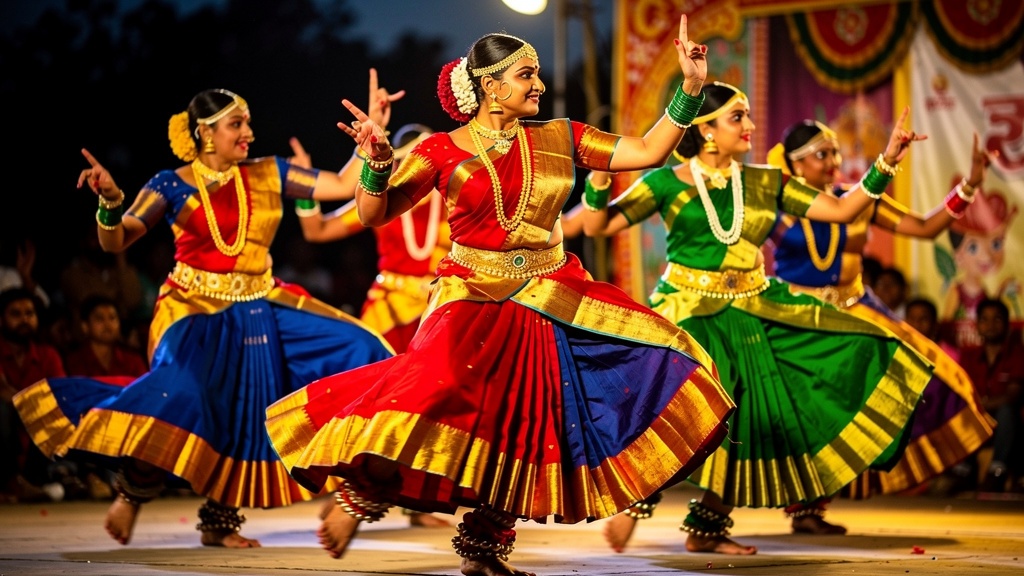
The performing arts of the Deccan region encompass some of India's most sophisticated and vibrant folk traditions, and Ahilyanagar has long been a significant centre for many of these art forms. Understanding these traditions enriches any visit to the district — if you are lucky enough to encounter a live performance during your stay, you will gain an experience that no museum display can replicate.
Lavani is perhaps the most internationally recognized of Maharashtra's folk performance traditions, and justifiably so. This form combines powerful rhythmic music — dominated by the dholki drum — with energetic dance that is simultaneously sensuous, athletic, and narratively rich. Lavani emerged in the Deccan region in the 18th century, initially as entertainment in the tents of Maratha military camps, and evolved into a sophisticated performance tradition patronized by the Peshwa court at Pune and later by the nobility of various Deccan states. The songs deal with a wide range of subjects — romantic love, social observation, mythology, and political commentary — delivered in the characteristically earthy and direct idiom of the Marathi folk tradition.
Tamasha is the broader theatrical form within which Lavani performances typically occur. A Tamasha production combines comic dramatic sketches (vag) with Lavani songs and dance, and was historically performed by itinerant troupes travelling between villages and markets. Though the traditional performance circuit has contracted in the contemporary media environment, Tamasha troupes continue to perform across rural Maharashtra, particularly during festival seasons, and a genuine Tamasha performance — typically running through the night — is an immersive experience of folk entertainment at its most vital.
Equally important to the cultural life of Ahilyanagar is the tradition of Kirtan — the devotional narrative singing that forms the core performance mode of the Warkari sect. A kirtankar (Kirtan performer) weaves together saint poetry, mythology, philosophical exposition, and social commentary into a flowing performance that can last several hours. The great Marathi saints — Tukaram, Dnyaneshwar, Namdev, Eknath — composed an extraordinary body of devotional poetry (abhangas) that remains the core repertoire of the Kirtan tradition, and these compositions are as musically and intellectually rich as any Indian devotional literature.
During major religious observances and festival seasons, Kirtan performances take place nightly in temple compounds across the district. Visitors who attend these performances — even without understanding Marathi — often find them deeply moving, the combination of musical energy, communal participation, and genuine spiritual intensity creating an atmosphere quite unlike any formal concert setting.
One of the most distinctively Maharashtrian musical traditions is the Powada — the heroic ballad form that celebrates the deeds of Chhatrapati Shivaji Maharaj and other Maratha heroes. Powadas are typically performed by a single singer accompanied by percussion and string instruments, and the narratives combine historical fact with heroic embellishment to create a tradition that is simultaneously musical performance and communal memory. Shahir (bard) Agnidas created one of the most celebrated Powadas in honour of Shivaji's victories; the tradition continues to be actively performed and new compositions celebrating contemporary heroes are periodically added to the repertoire.
The tradition of the Shahir — the poet-singer who gives voice to the community's political and social aspirations — has a particularly rich history in Ahilyanagar. The district produced several notable Shahirs in the 19th and 20th centuries whose compositions addressed social reform, anti-caste struggle, and political liberation with equal lyrical force. Their work continues to be performed and is an important component of the district's living cultural heritage.
From Nizam Shahi fortifications to Hemadpanthi temples, the district's built environment spans nine centuries of artistic achievement.
The architectural heritage of Ahilyanagar is unusual among Indian districts in spanning such a wide chronological and stylistic range. The district contains monuments that range from early medieval Hindu temple architecture to the Indo-Persian synthesis of the Deccan Sultanates, from Maratha-era hill forts to Victorian colonial institutions, from experimental modernist cooperatives to vernacular tribal dwellings that have remained essentially unchanged for centuries. Each layer tells a story about the people who built it and the world they inhabited.
The most distinctive architectural contribution of the Ahilyanagar region is the tradition of the Nizam Shahi Sultanate, which flourished between 1490 and 1636 CE. The Nizam Shahi builders, working in the basalt of the Deccan plateau, created a distinctive synthesis of Persian, Timurid, and local Deccani traditions that is recognizable as its own idiom. The characteristic elements of this style include: smooth basalt ashlar construction of remarkable precision; pointed arches of a slightly flattened profile; domes with slightly pointed profiles influenced by Persian precedent; octagonal plans favoured for tombs and towers; and a relative restraint in external decoration compared to the more exuberant Bijapur or Golconda schools.
The finest examples in Ahilyanagar include the Ahmednagar Fort (already discussed in the Places section), Salabat Khan's Tomb (a two-storeyed octagonal masterpiece near the city), the Damdi Masjid (an elegant congregational mosque with graceful Persian-influenced minarets), and the Bhadkal Gate (a triumphal arch of excellent proportions).
What makes the Nizam Shahi buildings of Ahilyanagar particularly interesting is that they are, on the whole, less well-known and therefore less visited than the more famous monuments of Bijapur, Golconda, or Aurangabad. This means that a visitor to Ahmednagar can explore these excellent buildings in relative peace, without the crush of tour groups that characterizes visits to the more famous Deccan heritage sites.
Before the Sultanate period, the region was home to a thriving tradition of Hindu temple construction in the Hemadpanthi style — named after the 13th-century Yadava minister Hemadri (Hemadpant) who is credited with systematizing a particular approach to construction using black Deccan basalt without the use of mortar. Hemadpanthi temples are distinguished by their distinctive stepped plans, the precise interlocking of basalt blocks, and a decorative vocabulary derived from the Nagara (North Indian) temple tradition as interpreted through the Deccani sensibility.
Several Hemadpanthi temples survive in reasonable condition across the district, though some require a degree of detective work to locate. The Mhasoba temple complex near Ahmednagar and various village temples in the rural talukas preserve examples of this style that deserve attention from heritage-conscious visitors.
The British colonial period left a significant architectural imprint on Ahmednagar city. The British established a major military cantonment here — the Ahmednagar Cantonment — and the associated institutional buildings, residential bungalows, churches, and administrative structures created a substantial Victorian architectural landscape that survives in varying states of preservation.
The colonial-era buildings of the cantonment area include several handsome bungalows in the Anglo-Indian style, a well-preserved church, and various institutional structures in the Gothic Revival and Classical modes characteristic of mid-Victorian public architecture in India. These buildings provide a fascinating counterpoint to the Sultanate monuments in the old city, together creating an architectural palimpsest that maps the district's complex political history onto its built environment.
The army's occupation of the fort and cantonment ensures that these colonial-era structures are well-maintained, and several of the cantonment roads offer pleasant walks through a landscape that feels remarkably similar to an English market town transported to the Deccan plateau, with bougainvillea replacing the roses and the Sahyadri silhouette replacing the English hills on the horizon.
Few things reveal the soul of a place as clearly as the way its people celebrate, and Ahilyanagar's festival calendar is a rich revelation of the district's cultural complexity, religious diversity, and deep-seated capacity for collective joy. Throughout the year, celebrations punctuate daily life with extraordinary colours, sounds, and emotions — from the thunderous percussion of Dhol-Tasha groups processing through the streets during Ganesh Chaturthi to the contemplative stillness of Amartithi at Meherabad, from the agricultural thanksgiving of Makar Sankranti to the exuberant colours of Holi as celebrated in the district's many tribal communities.
Ganesh Chaturthi is without question the festival that most completely expresses Maharashtrian cultural identity, and in Ahilyanagar, as across the state, it is celebrated with an intensity that visitors from outside Maharashtra consistently describe as one of the most extraordinary cultural experiences of their lives. The festival, which falls in August or September according to the lunar calendar, commemorates the birth of Lord Ganesha — the elephant-headed son of Shiva and Parvati, the remover of obstacles and patron of new beginnings — and continues for ten days culminating in the immersion (visarjan) of Ganesha idols in rivers and tanks.
The preparations for Ganesh Chaturthi in Ahmednagar city and across the district begin weeks before the festival proper. Local artists craft Ganesha idols in every size from palm-height domestic figures to enormous community installations that require specially constructed mandaps (pavilions). The competitive element between neighbourhood committees (mandals) in creating the most spectacular installation drives a creative tradition that has produced some genuinely stunning public art over the years.
The immersion procession on the final day — Anant Chaturdashi — is the festival's most dramatic moment. Thousands of Ganesha idols of all sizes are carried in procession to the immersion points, accompanied by Dhol-Tasha percussion groups playing in the driving, hypnotic style that has become globally recognized as the sound of Maharashtra. The atmosphere combines mass devotion with carnivalesque energy in a way that is uniquely Indian and unforgettable for any visitor fortunate enough to be present.
The birthday of Lord Shani, falling on the new moon (Amavasya) of the Hindu month of Jyeshtha (typically May or June), brings extraordinary crowds to Shani Shingnapur. The temple receives an estimated 40,000 or more visitors on this single day, and the surrounding villages are filled with pilgrims who have travelled from every corner of India. The atmosphere combines intense religious energy with the festive excitement of a major fair, and the night before Shani Jayanti — when the temple is illuminated and devotional singing continues through the night — is one of the most atmospherically charged experiences available to the visitor in the district.
The Wari — the biannual pilgrimage to Pandharpur in honour of Lord Vitthal — is one of Maharashtra's most ancient and compelling religious traditions, and Ahilyanagar district participates deeply in this tradition. Lakhs of Warkaris (pilgrims in the Wari tradition) pass through the district's roads twice yearly — in the months of Ashadha and Kartika — walking in procession, singing abhangas (devotional compositions of the Bhakti saints), and maintaining a remarkable discipline of communal life during the journey that turns the roads of rural Maharashtra into a moving spiritual community.
Watching or joining a section of the Wari procession is one of the most genuinely moving experiences available in Maharashtra. The sense of community — cutting across caste, gender, and economic lines — and the quality of devotional attention that the Warkaris bring to their journey create an atmosphere of spiritual intensity that has impressed observers from Mahatma Gandhi to contemporary travel writers.
Amartithi (31 January) marks the anniversary of Meher Baba's passing in 1969, and is observed at Meherabad with gatherings that draw devotees from over 80 countries. The day begins at dawn at the Samadhi with readings from Baba's discourses and continues with programmes of music, prayer, and community throughout the day. The international flavour of the Amartithi gathering — Westerners, Iranians, Indians, Australians, and visitors from dozens of other countries all converging on this quiet Maharashtra village — creates a remarkably cosmopolitan atmosphere in an otherwise rural setting.
| Festival | Month | Key Location | Significance |
|---|---|---|---|
| Amartithi | January 31 | Meherabad | Meher Baba remembrance |
| Makar Sankranti | January | District-wide | Harvest thanksgiving, kite flying |
| Shani Jayanti | May/June | Shani Shingnapur | Shani's birthday — largest gathering |
| Ashadhi Wari | June/July | District roads | Pilgrimage to Pandharpur |
| Ganesh Chaturthi | Aug/Sep | Ahmednagar city & villages | Maharashtra's supreme festival |
| Navratri | October | District-wide | Nine-night goddess celebration |
| Diwali | October/November | District-wide | Festival of lights |
| Kartiki Wari | November | District roads | Second annual Pandharpur pilgrimage |
| Eid-ul-Fitr | Variable | Old city mosques | Muslim community celebration |
 🍽️ Authentic Deccan Flavours
The cuisine of Ahilyanagar is inseparable from the broader tradition of Maharashtrian cooking, but the district's specific agricultural character — sugarcane country with significant peanut, onion, and pulse production — gives the local food its distinctive flavour profile. This is a cuisine that works confidently with complex spice combinations, that is unafraid of heat, that balances sweet and sour elements with unusual sophistication, and that relies on a pantry of ingredients — peanuts, dried coconut, sesame seeds, tamarind, kokum — that are peculiarly its own.
The most important thing to understand about Maharashtrian cuisine in Ahilyanagar is that the best food is typically found not in restaurants but in domestic kitchens, in the homes of families who have been making the same dishes for generations with produce grown in their own fields. The second best is at the modest, no-frills dhabas and local eateries that serve genuine home cooking to working people on tight schedules. Tourist restaurants, while improving, are generally the last choice for an authentic experience.
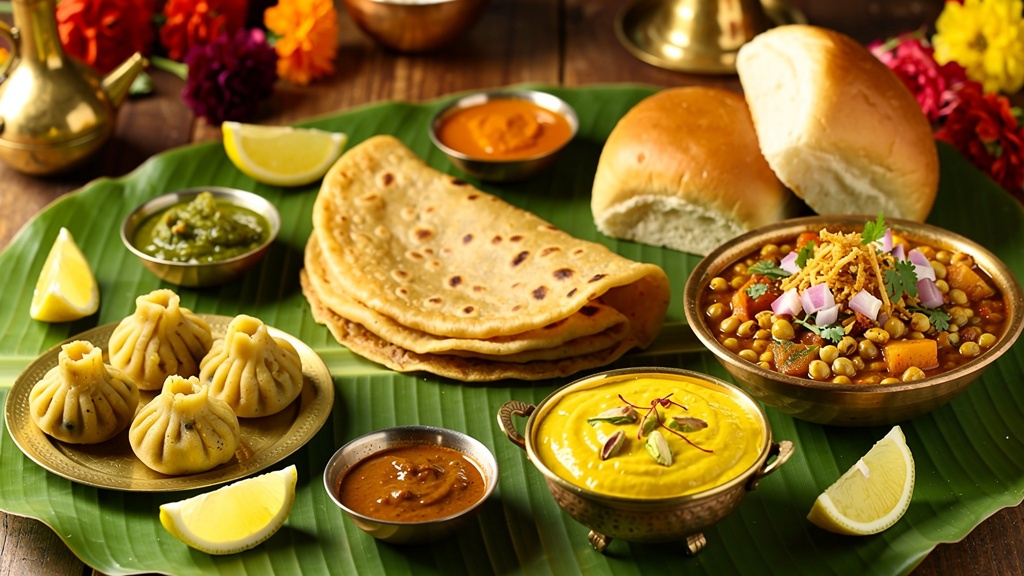
If Maharashtra had a single dish that most completely encapsulated its culinary character, it would be Misal Pav. At its simplest, Misal is a spiced curry of sprouted moth beans (matki) or a mixture of sprouts, served in a bowl alongside usal gravy, topped with farsan (crunchy gram flour noodles), chopped onion, tomato, lemon, and a drizzle of thick spicy gravy called kat. The accompanying Pav (soft white bread rolls) is used to scoop up the mixture.
What makes Misal remarkable is the astonishing variation in preparation style across different towns and restaurants — the Kolhapuri version is intensely spicy, the Nashik version is somewhat milder, the Pune version incorporates certain distinctive spice combinations, and the Ahmednagar version has its own local character. Connoisseurs argue fiercely about which regional version is superior, and the question is genuinely unanswerable as each version has its devoted adherents. What is universally agreed upon is that a well-made Misal — spicy, complex, texturally layered, and served steaming hot — is one of the great street food experiences of India.
In Ahmednagar city, several well-established dhabas serve Misal that locals rate among the finest in the district. The traditional breakfast hour (7–10 AM) is the best time to visit these establishments; the Misal preparation is usually done fresh each morning and the quality peaks in the early hours.
The festival cuisine of Ahilyanagar follows the Maharashtra-wide tradition of specific dishes associated with specific celebrations. Puran Poli — the sweetened lentil-stuffed flatbread — is the supreme festival bread, prepared for Holi, Ganesh Chaturthi, Gudi Padwa, and various family celebrations. The skill required to make a good Puran Poli — getting the filling consistency right, rolling the bread thin enough to cook quickly without the filling breaking through, achieving the perfect balance of sweetness — is a benchmark of domestic cooking skill that Maharashtrian women (and increasingly, men) take considerable pride in.
Modak is Lord Ganesha's favourite offering and an indispensable part of Ganesh Chaturthi feasting. These steamed or fried rice flour dumplings stuffed with sweet coconut and jaggery filling are prepared in enormous quantities in every home during the festival season, and the best home-made modak — particularly the traditional ukadiche modak (steamed version) — are one of the finest sweets produced anywhere in Indian regional cuisine.
Shrikhand, the thick sweetened strained yogurt flavoured with saffron, cardamom, and nutmeg, is Maharashtra's most refined sweet, and local versions made with the curd of indigenous cow milk are substantially superior to anything available in cities. Served with Puri (deep-fried puffed bread) as Shrikhand-Puri, this combination is the definitive festive meal accompaniment across the district.
While Brahminical Pune associations have given Maharashtra an (only partially deserved) reputation for vegetarianism, the majority of Ahilyanagar's population consumes meat, and the non-vegetarian traditions of the district are substantial. Mutton dishes hold a particular place of honour — the Mutton Kolhapuri style curry, intensely spiced with the fiery Kolhapuri masala, is one of India's most robustly flavoured meat preparations. Chicken Rassa (a thin, intensely spiced chicken curry) and various preparations of dried fish (Bombil/Bombay duck, dried prawns incorporated into chutneys and curries) are also important parts of the regional culinary landscape.
The Kombdi-Vade combination — a thin, tangy chicken curry served with fried bread made from the local vade flour — is a regional favourite particularly associated with Malvani and Deccan coastal cooking influences that have percolated inland to Ahilyanagar's food culture.
Ahilyanagar's position as a major sugarcane-producing district means that jaggery (gur) — the unrefined sugar produced by boiling down sugarcane juice — is both a local product and a cultural touchstone. Maharashtrian cooking uses jaggery in ways that go far beyond sweetening: as a base for chutneys, as a souring agent in curries, as a binding element in laddoos and other confections, and as a simple daily condiment consumed with warm chapattis and pure ghee. The jaggery produced in Ahilyanagar — particularly the dark, smoky variety made using traditional open-fire methods — has a depth of flavour that industrial white sugar can never replicate, and picking up a block of good local jaggery at a market is one of the most rewarding and authentic food souvenirs available in the district.
The material culture of Ahilyanagar encompasses a range of traditional crafts that are both beautiful in themselves and deeply expressive of the region's cultural values. While many traditional crafts are under pressure from machine-made alternatives, several maintain living traditions supported by a combination of domestic use, festival demand, and growing recognition from collectors and heritage-conscious buyers.
Though the Paithani silk weaving tradition is centered on Paithan in the neighbouring Aurangabad district, its influence extends throughout the Marathwada and Western Maharashtra region, and Ahilyanagar has its own weaving heritage closely related to this tradition. Paithani sarees — woven from pure silk with a distinctive tapestry weave that creates the characteristic peacock-and-flower borders and pallu (end-piece) — are among India's most prized textiles, and authentic handwoven examples can take months to produce. The Paithani is the definitive prestige textile of Maharashtrian women, worn at weddings, religious ceremonies, and significant family occasions, and its distinctive patterns are instantly recognizable as markers of cultural identity.
Visitors interested in weaving can visit the workshops and cooperative societies in several towns within the district where traditional weaving continues, observing the production process and purchasing directly from weavers — a transaction that benefits artisans directly and ensures the purchase of genuine handwoven cloth rather than power-loom imitations.
The Deccan metalworking tradition, which reached its apex in the Bidriware inlay work associated with Bidar in Karnataka, has extended influence in the Ahmednagar region. Local metalworkers produce a range of decorative and utilitarian objects in brass, copper, and bronze, including the distinctively Maharashtrian tamhan (bronze plate) used for religious and festive meals, and various lamp forms used in temple ritual.
Every village in Ahilyanagar has its potter's community, and the earthenware produced by local kumhars (potters) ranges from humble utilitarian water pots (matkas) to decorative figurines for domestic shrines. The festival seasons particularly stimulate pottery production: Ganesh Chaturthi creates demand for clay Ganesha idols, various calendar festivals require specific terracotta ritual objects, and the daily consumption of tea and buttermilk from fresh clay cups is maintained in many rural areas as a preferred practice.
The tribal communities of the Akole and Sangamner talukas — particularly the Mahadeo Koli and Thakar communities — maintain sophisticated traditions of bamboo basketry, grass weaving, and leaf-plate making that combine functional utility with remarkable aesthetic refinement. The baskets made by these communities for storing grain, carrying produce, and serving food are created using weave patterns of considerable complexity and visual elegance. These crafts are gradually being recognized beyond their domestic contexts, with several NGOs and cooperative initiatives working to connect tribal artisans with urban and international markets.
The prodigy saint who composed the Dnyaneshwari — a Marathi commentary on the Bhagavad Gita — at the age of fifteen. Though centered on nearby Alandi, his spiritual influence permeates the entire Western Maharashtra region. The Dnyaneshwari remains Maharashtra's greatest literary monument.
Ahmad Nizam Shah I establishes the Nizam Shahi Sultanate with Ahmednagar as its capital, beginning a 140-year period of Deccan Sultanate culture that produces the architectural legacy that remains the district's most visible heritage.
Maharashtra's most beloved saint-poet, whose abhangas (devotional compositions) in colloquial Marathi democratized spiritual expression and created a body of poetry that remains in daily use across the region. Tukaram's influence on the social ethics and spiritual culture of Ahilyanagar is profound and ongoing.
The mystic Meher Baba establishes his spiritual community near Ahmednagar, bringing together disciples from across India and the world. Beginning his silence in 1925, he continues to teach through gestures and an alphabet board until his passing in 1969, leaving a message of universal love that continues to draw seekers.
Maharashtra renames the district Ahilyanagar in honour of the great Maratha queen Ahilyabai Holkar, born in the region. This decision celebrates the district's deep connection to one of India's most enlightened and compassionate rulers.
No account of Ahilyanagar's cultural heritage is complete without a detailed appreciation of Ahilyabai Holkar (1725–1795), the Maratha queen whose name the district now bears. Born in Chondi village (near Jamkhed in the present district), Ahilyabai rose from humble origins to become one of the most enlightened rulers in Indian history — a distinction conferred not merely by official hagiography but by the extraordinary material legacy she left across the subcontinent.
As the ruler of the Holkar state of Malwa (headquartered at Maheshwar, Madhya Pradesh), Ahilyabai governed for thirty years (1765–1795) with a combination of administrative genius, personal piety, and profound empathy for the welfare of her subjects. During her reign, she constructed or restored temples, dharmashalas (pilgrim rest houses), and ghats at sacred sites across India — at Kashi (Varanasi), Gaya, Somnath, Ujjain, Nashik, Puri, Dwarka, Haridwar, and many others. The Kashi Vishwanath Temple complex in Varanasi, originally destroyed by Aurangzeb, was rebuilt by Ahilyabai in 1777 CE and is one of her most celebrated acts of cultural restoration.
Ahilyabai governed without a male regent despite her widowhood and the social norms of her time, maintained a formidable military force commanded by the general Tukoji Holkar, administered justice with legendary impartiality, and is remembered in the folk memory of regions she never physically visited as a near-mythical figure of benevolent power. Her governance philosophy — rooted in dharmic duty rather than personal aggrandizement — is frequently invoked in contemporary Maharashtra as a model for public service.
The renaming of the district to Ahilyanagar in her honour is both a recognition of her geographic origins in the area and a statement of values — an assertion that Maharashtra is proud to see this quality of leadership and this depth of humanitarian commitment as defining characteristics of its identity.
From ancient Lavani performances to contemporary festival celebrations — plan your trip to coincide with the district's most vibrant cultural events.